Reference
Layers
Linear Regression
-
class
theano_wrapper.layers.LinearRegression(regularizer_fn=None, shape=None, X=None)¶ Simple Linear Regression. Linear regression is a linear predictor modeling the relationship between a scalar dependent variable
 and one or more explanatory
variables denoted
and one or more explanatory
variables denoted  from an input sample
  . The target
value is given by the formula:
. The target
value is given by the formula: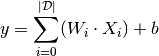
Parameters: - n_in (int) – Number of input nodes
- n_out (int) – Number of output nodes
-
X¶ theano variable – Symbolic input.
-
y¶ theano variable – Symbolic output.
-
W¶ theano variable – Weights matrix, shape=(n_in, n_out).
-
b¶ theano variable – Bias vector, shape=(n_out,).
-
predict¶ theano expression – Predict target value for input X.
-
cost¶ theano expression – Mean squared error loss function.
Logistic Regression
-
class
theano_wrapper.layers.LogisticRegression(regularizer_fn=None, shape=None, X=None)¶ Multi-class Logistic Regression.
Logistic regression is a probabilistic, linear classifier. It is parametrized by a weight matrix
 and a bias vector
  .
Classification is done by projecting an input vector onto a set of
hyperplanes, each of which corresponds to a class. The distance from the
input to a hyperplane reflects the probability that the input is a member
of the corresponding class.
.
Classification is done by projecting an input vector onto a set of
hyperplanes, each of which corresponds to a class. The distance from the
input to a hyperplane reflects the probability that the input is a member
of the corresponding class.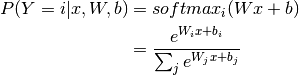
The model’s prediction
 is the class whose probability
is maximal, specifically:
is the class whose probability
is maximal, specifically:
Parameters: - n_in (int) – Number of input nodes
- n_out (int) – Number of output nodes
-
X¶ theano variable – Symbolic input.
-
y¶ theano variable – Symbolic output.
-
W¶ theano variable – Weights matrix, shape=(n_in, n_out).
-
b¶ theano variable – Bias vector, shape=(n_out,).
-
predict¶ theano expression – Return the most probable class (the probability function as described above).
-
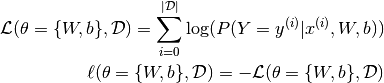
cost¶ theano expression – Negative log-likelihood if we define the likelihood
 and loss
  :
:
-
probas¶ theano expression – Calculate probabilities for input X.
Multi-layer Regression
-
class
theano_wrapper.layers.MultiLayerRegression(n_in, n_hidden, n_out, random=None)¶ Multilayer Regression.
An MLP can be viewed as a linear regression predictor where the input is first transformed using a transformation
 . This
transformation projects the input data into a more sparse or dense space.
This intermediate layer is referred to as a hidden layer. Formally,
a one-hidden-layer MLP is a function
. This
transformation projects the input data into a more sparse or dense space.
This intermediate layer is referred to as a hidden layer. Formally,
a one-hidden-layer MLP is a function  ,
where is the size of input vector
,
where is the size of input vector  and
and  is
the size of the output vector
is
the size of the output vector  , such that, in matrix notation:
.. math:
, such that, in matrix notation:
.. math:f(x) = G( b^{(2)} + W^{(2)}( s( b^{(1)} + W^{(1)} x))),
with bias vectors
 ,
,  ; weight matrices
 ,
,  and activation functions
  and
and
 . The vector
  constitutes the hidden layer.
  is
the weight matrix connecting the input vector to the hidden layer.
Each column
is
the weight matrix connecting the input vector to the hidden layer.
Each column  represents the weights from the
import input units to the i-th hidden unit. This estimator’s
is the Rectified linear unit output, or
represents the weights from the
import input units to the i-th hidden unit. This estimator’s
is the Rectified linear unit output, or  function.
Parameters: - n_in (int) – number of input nodes
- n_hidden (int or list(int)) – if int this is the number of hidden layer nodes in a single-hidden-layer network. If list of int’s this is a list of number of nodes for len(n_hidden) successive layers
- n_out (int) – number of output nodes
- random (Optional(int or numpy.random.RandomState instance)) – an integer seed or random state generator. Default: None, links to np.random
-
layers¶ list – List of all the estimator layers with layers[0] being the input layer, layer[1:-1] being the hidden layers and layers[-1] the output layer.
-
X¶ theano variable – Symbolic input of first layer.
-
y¶ theano variable – Symbolic output of last layer.
-
params¶ list – Vector of all the estimator parameters, i.e. weights and biases of all the layers
-
predict¶ theano expression – Return the most probable class (the probability function as described above).
-
cost¶ theano expression – Negative log-likelihood from LogisticRegression.
Multi-Layer Perceptron
-
class
theano_wrapper.layers.MultiLayerPerceptron(n_in, n_hidden, n_out, random=None)¶ Multilayer Perceptron.
An MLR can be viewed as a logistic regression classifier where the input is first transformed using a learnt non-linear transformation
. This transformation projects the input data into a space
where it becomes linearly separable. This intermediate layer is referred
to as a hidden layer.Formally, a one-hidden-layer MLR is a function
, where is the size of input
vector and is the size of the output vector
, such that, in matrix notation:
with bias vectors
, ; weight matrices
, and activation functions and
. The vector
constitutes the hidden layer. is
the weight matrix connecting the input vector to the hidden layer.
Each column represents the weights from the
import input units to the i-th hidden unit. This estimator’s
is the  function.
Parameters: - n_in (int) – number of input nodes
- n_hidden (int or list(int)) – if int this is the number of hidden layer nodes in a single-hidden-layer network. If list of int’s this is a list of number of nodes for len(n_hidden) successive layers
- n_out (int) – number of output nodes
- random (Optional(int or numpy.random.RandomState instance)) – an integer seed or random state generator. Default: None, links to np.random
-
layers¶ list – List of all the estimator layers with layers[0] being the input layer, layer[1:-1] being the hidden layers and layers[-1] the output layer.
-
X¶ theano variable – Symbolic input of first layer.
-
y¶ theano variable – Symbolic output of last layer.
-
params¶ list – Vector of all the estimator parameters, i.e. weights and biases of all the layers
-
predict¶ theano expression – Return the most probable class (the probability function as described above).
-
cost¶ theano expression – Negative log-likelihood from LogisticRegression.
Trainers
Epoch-based
-
class
theano_wrapper.trainers.EpochTrainer(clf, alpha=0.01, max_iter=10000, patience=5000, p_inc=2.0, imp_thresh=0.995, random=None, verbose=None)¶ Simple epoch-based trainer using Gradient Descent with patience. The idea is that we train for at least n (patience) epochs and then if the score keeps getting better (biased by imp_thresh) we elongate the training session by a factor of p_inc.
Parameters: - clf – the estimator to train
- alpha (float) – learning rate
- max_iter (int) – max_iterations to go through
- patience (int) – look at least that many samples
- p_inc (float) – how many more samples to fit after each improvement
- imp_thresh (float) – the limit of what to consider improvement
- random (int or random state generator) – a random state for predictable results
- verbose (int) – verbosity factor. None = off, n = every n periods
-
gradients¶ theano symbolic function – The gradient for each parameter.
-
updates¶ theano symbolic function – Compute update values.
-
fit(X, y)¶ Train estimator using input samples. This implementation will automatically split the input into an 80% training and an 20% validation set
-
predict(X)¶ Return estimator prediction for input X
Stohastic Gradient Descent
-
class
theano_wrapper.trainers.SGDTrainer(clf, batch_size=None, alpha=0.01, max_iter=10000, patience=5000, p_inc=2.0, imp_thresh=0.995, random=None, verbose=None)¶ Stohastic Gradient descent trainer with patience. This classifier works in a similar way to EpochTrainer, but instead of fitting all the samples it splits them to minibatches and go through a subset of all the samples at a fit period. This allows for speed improvements with large datasets and off-line training, i.e. training without all the samples available at once.
Parameters: - clf – the estimator to train
- batch_size (int or None) – how many samples to consider for each training batch. if None, it is set to int(n_samples/100)
- alpha (float) – learning rate
- max_iter (int) – max_iterations to go through
- patience (int) – look at least that many samples
- p_inc (float) – how many more samples to fit after each improvement
- imp_thresh (float) – the limit of what to consider improvement
- random (int or random state generator) – a random state for predictable resi;ts
- verbose (int) – verbosity factor. None = off, n = every n periods
-
gradients¶ (theano symbolic function) The gradient for each parameter
-
updates¶ (theano symbolic function) Compute update values
-
fit(X, y)¶ Train estimator using input samples. This implementation will automatically split the input into an 80% training and an 20% validation set
-
predict(X)¶ Return estimator prediction for input X
Regularizers
L1 / L2 squared
-
theano_wrapper.trainers.l1_l2_reg(l1_reg=0.0, l2_reg=0.0001)¶ L1 and L2 squared regularization.
L1 and L2 regularization involve adding an extra term to the loss function, which penalizes certain parameter configurations. For a loss function
 of the prediction function f parameterized
by
of the prediction function f parameterized
by  on data set
  , the regularized loss
will be:
, the regularized loss
will be:
or, in our case:

where
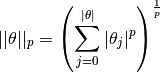 is a set of all parameters for a given model,
 the hyper-parameter which controls the relative
importance of the regularization parameter and
the hyper-parameter which controls the relative
importance of the regularization parameter and  the
regularization function. Commonly used values for
the
regularization function. Commonly used values for  are 1 and 2, hence the L1/L2 nomenclature. If
  , then the
regularizer is also called “weight decay”.
, then the
regularizer is also called “weight decay”.In this model both L1 and L2 regularization is supported.
Parameters: - clf – an estimator
- l1_reg (float) – The l1 regularization parameter. Defaults to .0
- l2_reg (float) – The l2 regularization parameter. Defaults to .0001
Returns: - Symbolic expression that calculates the
regularized cost.
Return type: cost (theano expression)
Example:
clf = SomeClassifier(*args)
reg = l1_l2_reg(clf, 0.0001, 0.001)
trn = SomeTrainer(clf, reg=reg)
[...]